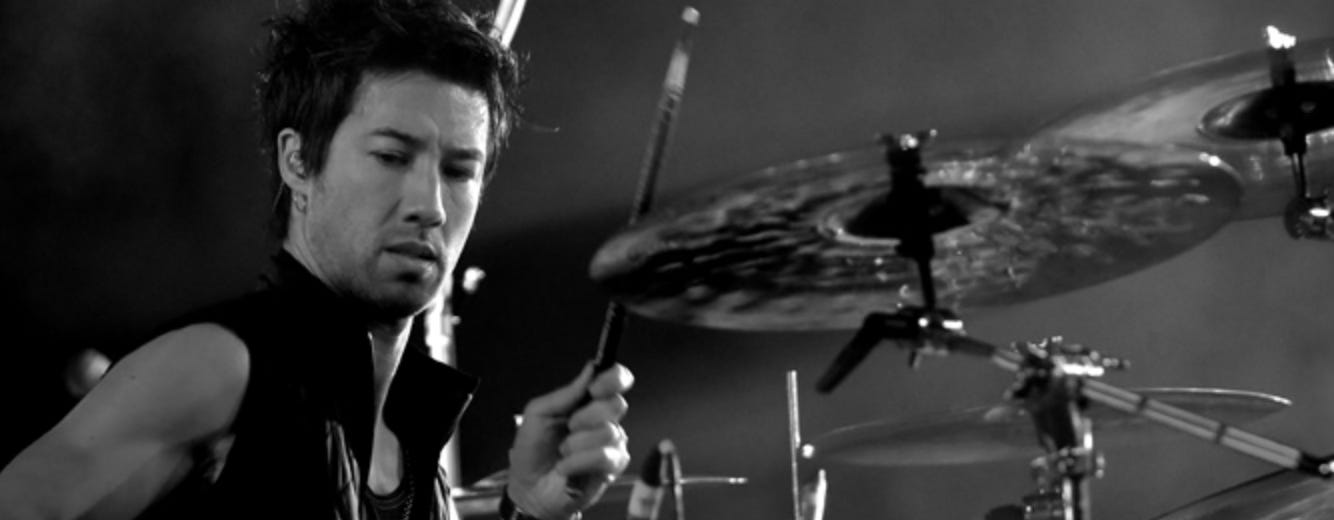

Director’s Note: “What struck me about Brendan isn’t just the résumé—it’s the mindset. He represents a kind of modern musician who survives not by ego or flash, but by awareness, preparation, and humility. In an era where technology, tracks, and pressure dominate live performance, Brendan reminds us that adaptability is artistry—and that curiosity, not perfection, is what sustains a career.”
From Punk Roots to Global Stages
The conversation opens with Brendan Buckley tracing his journey from New Jersey punk and metal scenes to becoming one of the most adaptable drummers in modern music. He reflects on early influences—from Rush and Bad Brains to jazz and rudimental training—and how studying broadly allowed him to thrive in wildly different musical environments.
Serving the Song, Whatever the Genre
Buckley breaks down the realities of working with artists as diverse as DMX, Shakira, Julio Iglesias, and Perry Farrell. From last-minute auditions to electronics-heavy live rigs, he explains how preparation, flexibility, and calm problem-solving are essential when everything can—and will—go wrong onstage.
Creativity, Humility, and Longevity
Beyond technique, the discussion turns philosophical: how to balance personal identity with service, why not trying to please everyone is key to mental health, and how walking a city, staying physically loose, and remaining curious keeps creativity alive. It’s a candid masterclass in surviving—and thriving—as a working drummer in the modern era.
Watch video version here:
RAW TRANSCRIPT (Pardon the old-school glitches):
Brendan Buckley: Hi. Can you hear me?
Ari Gold: I can. Greetings. I’m just pinning this pin away. Pin away. Greetings. Good morning. Where are you?
Brendan Buckley: Los Angeles. You?
Ari Gold: We could have met in person.
Brendan Buckley: We still have time. Where are you?
Ari Gold: What part of town? Oh my god. So—my [place], we’re a few blocks. You could probably shout out the window and say hi to me.
Brendan Buckley: Do you live there?
Ari Gold: I’m here for a couple of days. I used to live here and I’ve sort of become a perpetual traveler. But yeah. How was that thunderstorm last night, huh?
Brendan Buckley: Yeah. Last night and this morning. Yeah—I got up early to do… I had like a little class to do this morning. And it was thundering the whole way through.
Ari Gold: It’s nice. A class meaning—you were teaching something online, or…?
Brendan Buckley: No. I went to a wrestling / martial arts beat-down class at 7 AM this morning. And it was fun because it had a soundtrack this morning.
Ari Gold: Yeah. That followed by the car alarms.
Brendan Buckley: That also. Yeah, yeah. Well, there’s much-needed rain here in California. So it’s a welcome thunderstorm.
Ari Gold: Yeah, exactly. Well, thank you so much for joining me on hotsticks.fm—otherwise known as airdrummer.com. We have one video, one audio. You are a master of many genres as a drummer. I see you’ve actually even got the drums behind you. For the audio version people won’t be able to see that, but—are those real drums? Rosetta Green script.
Brendan Buckley: I’m at a studio. This is my avatar. No, this is a drum set that I used yesterday on a recording for a friend of mine. So it—that’s a plug-in… Well, this is just an assortment of different things here. I mean, if you look around the room, there’s drums everywhere. But this one happens to be my ’60s Ludwig kit with a snare drum that’s an odd one. It’s actually called a Sherwood—S-H-E-R-W-O-D, I think. And I bought it at Pro Drum in LA, just because it looked old and cool. And it was very affordable because—what’s a Sherwood? And then I looked it up on the internet—apparently it was like an offshoot of Ludwig for a year or two. It’s the same thing. So it’s like a ’40s Ludwig snare with a different badge on it, and it sounds incredible.
Ari Gold: A jazzy feel in some way.
Brendan Buckley: It can. It can.
Ari Gold: I mean, there—that existed before rock music, which is kind of cool.
Brendan Buckley: There are certain drums… like maybe in the ’90s—I used to take every drum I would audition to buy, and I would just take it and start whacking rimshots on it and say, “Sounds good,” take it home. Whack, whack, whack—sounds pretty good. Because that’s how I played in the ’90s basically. And now there’s certain drums that sound really good when you just do the tip in the center of the snare drum, no rimshot thing. And there’s other drums that sound really good when you nail them like an aluminum baseball bat on a pipe, you know. So you have some tips. So sometimes I’ll look at drums and I’m like, I don’t think that’s the bashing rimshotty drum—that’s more of the tip-in-the-center kind of drum. And so you have your pile of snare drums that’s more for that style, and the pile of snare drums that’s more for whacking two and four with a rimshot—and you kind of separate them.
Ari Gold: How many snare drums do you have in your…?
Brendan Buckley: I’ve lost count. It varies from… I don’t know, 30 to 50, I guess. Well, it depends—depends on how much money I need. Or I sell a bunch and then I buy a few again. It fluctuates.
Ari Gold: As an air drummer, I can play all of your snare drums in my mind. Yeah. It’s very cheap.
Brendan Buckley: Very efficient also. Yeah.
Ari Gold: You’re with DW for hardware or…?
Brendan Buckley: I’ve been with DW drums since 2000 or 2001. I can’t remember exactly when I signed with them. But yeah—over 20 years. Drums and hardware. And LP percussion. Sabian cymbals since the late ’90s. Remo. Vic Firth. I’ve been with the same companies for—yeah, 20 years or longer.
Ari Gold: [Someone] on the board—he’s such a wonderful guy over at DW. And do you… Well—
Brendan Buckley: Yeah, I do. I’m only slightly over an hour drive away from their factory. So I’ll get the random email or phone call like, “Hey, what are you doing on Friday morning? You want to come up and do something with us?” And I’m a big fan of drum education in general—just all forms of drum education. So anytime anyone has any type of idea that involves getting drums out to the masses, I’m down. So I think DW is really good with that stuff.
Ari Gold: I mean, he was ahead of the curve. These days there’s so many Instagram drummers—people who are kind of getting their chops but never playing with other people because they become really proficient playing with their phone, playing along with music. I was talking with him about the difference between the kind of education people get from watching some Instagram drummer versus an actual pro drummer who plays with other people and can talk to them in a more measured way. What do you think you provide when you go up to a Drum Channel as a teacher online that someone isn’t going to get from an Instagram drummer with a million followers who—
Brendan Buckley: If I have no prompts and they say, “Just teach something,” then I’ll usually teach whatever I’m working on—or what I find works for me—or what helps me play the drums better. I’m always looking for cheat codes to get better at the drums, you know—discarding exercises that have no meaning to me and finding exercises that actually make me better at what I do. So if I find one, I’m like, “Oh, this is great. I wish I knew this 20 years ago.” I’m going to share this exercise. And so that’s usually what I teach.
However, what I found also works well is people just wanting me to tell stories—what it was like going from my teens to my 20s, or moving from here to here, or working with this person, working with that person. So I find that when it comes to teaching, part of it is me consciously passing on drum exercises or advice, and part of it is just me sharing stories.
Ari Gold: Yeah. I mean, I love hearing stories. I’ve got my own special questions based on your incredible roster of people you play with—like playing with someone like DMX and playing with Miley Cyrus. Those are a pretty different energy you’re going to have to bring on stage. Can you talk a little bit about working with DMX? I love DMX.
Brendan Buckley: Oh yeah—that was a random thing. I was living in Miami, and I did a lot of studio sessions there—just all sorts of things. And one day a guitarist friend of mine said, “Hey, I gave your number to the DMX crew. They’re looking at putting some live drums on their next album.” I’m like, “Wow, that’s awesome. I love this last record.” So cool. Sure enough I got a call from his manager saying, “What are you doing? Can you come by Criteria Studios?” So I showed up with a drum set, and there was just an engineer there. They said, “He’ll be here with his crew any moment now.” And that “any moment now” was probably six or eight hours later. So to kill that time we just recorded drums. We set up the drums. I said, “Well do you have the first song he wants to start with?” They’re like, “We do.” So he played me the song and I just played through it several times. Then finally he came in—shook hands, “Nice to meet you”—listened to it once, then went into the vocal booth and tracked vocals on top of it, double-tracked the vocals, did a hype track on top of that, said, “I love it, we’re done.” He wasn’t even there for me recording it. He had no notes for me. Just walked in: “Love it.” He freestyled a bunch of lyrics and I was blown away by how good he was and how quick he was. And that was it. Then at the end of the night he’s like, “Man, this is a great vibe. You want to go on tour with me?” I’m like, “Sure.” But that wound up never happening. I was totally excited to try that.
Ari Gold: Yeah. That would have been…Another one I have to ask about is Julio Iglesias Jr. Ah—well, that would be senior. That’s pretty bad. Was that in studio or live or both?
Brendan Buckley: That was live. But that’s not “To All the Girls I’ve Loved Before” Julio. So it was—also in Miami. His longtime drummer Lee Levin was a friend of mine, and he was leaving—or at least taking a hiatus from the band. So I got called to either fill in, sub, or take over the gig. My audition was: they sent me a 90-minute cassette tape of a live show. It said, “Learn the first six songs and fly out to our next soundcheck.” So I did that. I flew out to the soundcheck, met him, sat down, played the first six songs of his show with the band, and he said, “I love it. You will play the show tonight.” I looked around—“Well, I only learned the first six songs.” He’s like, “Well then you just play the first six songs tonight, and then my other drummer will hop back on the stage.” And that’s how I got the gig. It was great. I might have been 21 at the time.
Ari Gold: So you flew down there, you didn’t know you had the gig, and you were flying on your own dime to—
Brendan Buckley: No, they paid for me to fly in. It was basically a soundcheck rehearsal.
Ari Gold: Okay, that’s gentlemanly.
Brendan Buckley: Yeah. It was an audition, but I wasn’t expecting to get the gig that quickly. I thought I was gonna fly home and come out two weeks later or something.
Ari Gold: You weren’t expecting to play that night.
Brendan Buckley: Yeah. Then I had to quickly run across the street to a mall and get a long-sleeve button-down shirt and pants, because I probably had shorts and a tank top at that point. I’m like, “Oh shoot, I gotta go get ready.” So it was fun. It was great while it lasted.
Ari Gold: So when you’re doing a gig like that—whatever the drum tech sets up in front of you—you’re gonna play that? Or do you bring your own heads or cymbals or snare or foot pedal? What do you travel with when you’re a journeyman like that?
Brendan Buckley: It’s different for every situation. Certain gigs, I have my entire setup customized down to measurements and everything. That all goes into cases and goes on the road for eight months or 18 months and travels around the world with me and my drum tech. I set it up once, mark everything, memory lock everything, and it’s that way every night for the rest of the tour. The total opposite is I often fly into shows where they rent a kit from a local backline agency—like SIR or Center Staging—and they get as close as they can to my specs. So I’ll email: “Can you get me a DW with a 13 rack, 22-inch kick, 16 and 18 floor toms, a nickel-over-brass 6x14 snare, three crashes, ride, hi-hat,” and they’ll say, “We’ll get as close as we can.” Then I show up and see what they have, and I make it work. If it’s a Yamaha kit with Evans heads and ProMark sticks and Zildjian cymbals, I’m like, “Darn it. Well, let’s do this anyway.” And then there’s in-between: sometimes I’ll fly with my stick bag, my in-ears, maybe charts, a metronome, maybe a pedal, maybe cymbals, maybe a snare drum. But I’ve found traveling with less is easier. So I try to use as much rental gear as I can unless they can fly all of my stuff.
Ari Gold: Right. I’m traveling around as a filmmaker. I’ve got this mini kit I bring—one camera, one lens, one gimbal—carry-on. I like having gear I can carry onto a plane. Capability—like you can do your job anywhere. I was in Latvia and got called to film in Ukraine a few weeks ago. I shot a lot there. Having the opportunity to fly off somewhere—Liev Schreiber was going in and needed someone to drive around with him and it was like, “When are you doing that?” and they were like, “Tonight.” So there I went.
Brendan Buckley: And I suppose that your little travel kit is something you couldn’t have had 25 years ago either. Maybe you’d have a gigantic [rig] with a VHS tape in it… Now you’ve got a portable technological—
Ari Gold: I’ve got three microphones, a camera lens, a gimbal. I’ve shot a lot on it. I went down to Brazil and shot there for this show I’m putting together. Portability… I made a movie about air drumming where the idea is: you always have to have the heartbeat in you. You can’t rely on the gear. Try to live my life like my character—finding that capability within yourself and being ready at all times. Technology made that easier for film, but not so much for drums—you need your drums. I think someone is asking—someone saying you sounded great—Stu Brooks and Perry F… Speaking of Perry Farrell—do you want to talk about that?
Brendan Buckley: Oh, Perry is the best. I started working with him in 2018. He released a solo record and I got called to join his project Kind Heaven. Stu Brooks now plays in that band. It was Chris Chaney prior—Jane’s Addiction bassist. It’s a fun LA all-star cast—killer musicians. Perry’s wonderful. I grew up listening to Jane’s Addiction, so it was odd at first because I’d seen him live so many times. But he’s great. Super nice. Loves music. Positive. A joy to work with. We did a European tour. We were going to do South America right as the pandemic hit, so that was a bummer. But I have a gig with him next week, rehearsals this week, and I’m looking forward to seeing them again.
Ari Gold: You can tell him I saw Jane’s Addiction at The Stone on Broadway in San Francisco, and I think there were maybe 17 people there.
Brendan Buckley: What year was that?
Ari Gold: Late ’80s. Like ’88.
Brendan Buckley: That sounds about right. That was when they were still playing for 17 people.
Ari Gold: The show was a bit of a mess. A charming mess. But I was like—wow. They’re… “good enough” would be a way of putting it.
Brendan Buckley: So Perry’s doing a show here in LA where half the night is his solo band and half the night is Porno for Pyros with Stephen Perkins. It’ll be a good one. He’s so nice. He’s got the stage with him.
Ari Gold: I’d love to have him on the show. I don’t know if I’ve met him. I feel like I’ve met him… probably at an Ozomatli show. You played with Ozomatli too, right?
Brendan Buckley: I did. When I first moved to LA, their drummer at the time was Mario Calire—drummer for The Wallflowers and a bunch of other acts. He asked me to sub for them and it’s to this day one of the hardest gigs I ever had to sub. Learning that material was super challenging. It was so varied. So many stops and hits and unison sections. And they do everything different every night. It’s all on cue—watch the bassist for this, watch the sax player for this. I almost had a breakdown learning that set. I practiced for two weeks straight—every day—trying to get it together. Then I flew out to their first show. No rehearsal, just soundcheck. We ran maybe six songs at soundcheck and said, “Alright, cross your fingers.” Then we went into a festival tour: started in California, then Australia, Tasmania, New Zealand. It was a blast. Still friends with those guys. They’re so talented.
Ari Gold: Can you talk about your biggest choke on stage? People think about prepping for two weeks for Ozomatli or two hours for Julio Iglesias—things must have gone sideways. Something embarrassing, to make students feel better?
Brendan Buckley: Murphy’s Law: if it can go wrong, it will go wrong. You have to expect things to go wrong. Not wish them—but practice with those scenarios in mind: What if the singer doesn’t come in? What if my hi-hat falls apart? What if I can’t hear the click? What if the computer crashes? What if the bass drum head breaks? You have to have those scenarios in mind so it doesn’t shock you. I have enough experience now that I have the show down in a perfect scenario, but then I think: what if it’s not perfect? Can I still get through? A lot of acts have tracks—computers running tracks. That’s a whole mess. It’s gonna crash at some point. What I normally do: I have one set of in-ears wired into a pack—no wireless, straight into the monitor board. I also have a second set of in-ears onstage next to me. I have a second pack on my belt that’s wireless. If the first one dies, unplug and plug into the second. I also develop communication with the electronics person side-stage: cues for starting songs, stopping songs, what we do if something goes wrong, who do we follow if someone gets lost. You have to talk about it in advance so the first time it happens you’re not all looking around like, “What is going on?” Singer doesn’t come out from wardrobe change? Shut off the computer, vamp the intro, then when I look at you start the chorus—those kinds of plans. So if you want stories, there’s too many because everything can go wrong.
Ari Gold: Give me the one where you got home and were like, “Wow.” The nightmare one.
Brendan Buckley: Man… there’s dozens and dozens of moments like that. You just have to say: that was one show—move on. Don’t point fingers. Don’t freak out. Just move on. But I was subbing once for a friend. Not my show, not my rig, not my drum set. I learned the music. I sit down, start playing the show—live audience. Second song, my ears stop working. I don’t know why. I look around: did anyone else lose click and tracks? Everyone else keeps playing. So it must be me. I can’t hear the music. I slowly drop out. Everyone looks at me. I’m like—I don’t have headphones anymore. Normally I’d have backup packs, I’d see the monitor engineer, I’d see the tracks guy, I’d have a talkback mic. But it’s not my show. So I had to sit there until they fixed it—probably 30 seconds but felt like an hour. They sorted it out, and that’s why I’m adamant about having a system.
Ari Gold: So when you dropped out, the bassist kept going—was there a percussionist or backing tracks?
Brendan Buckley: Or loops? Loops and things.
Ari Gold: So it wasn’t a total drop-out of rhythm section.
Brendan Buckley: I don’t think so. I don’t remember. But yeah—things always go wrong. The key is you have to be good enough where the audience isn’t gonna notice. The band might notice and freak out, but make sure it’s not evident to the spectators.
Ari Gold: Yeah. In my movie Adventures of Power, his stool collapses at the end and he keeps air drumming. The show must go on. This—(for the video version) I pulled this off my shelf. I have a German-language version of the DVD that says “Luftgitarre war gestern,” which means “air guitar was yesterday.” Or drummer movie.
Brendan Buckley: That’s a motto to live by.
Ari Gold: A motto to live by. So—Shakira. How did you end up working with Shakira?
Brendan Buckley: That happened through a Miami thing. Gloria Estefan had a recording studio there that was prominent at the time. I don’t think it’s around anymore. I used to work there from time to time. Shakira came through Miami to record one of her records. The producer and engineer called me up and asked me to come by and throw some “rock drums” on one of the songs. So I came by and did that.
Ari Gold: When someone asks for “rock drums,” what does that mean?
Brendan Buckley: At the time—this was 1998—it meant she’s a pop artist but wants to sound more rock. As opposed to programming dance beats. Probably the demo had electronics, and they thought adding acoustic drums would give it more beef.
Ari Gold: Like John Bonham, or Steve Gadd.
Brendan Buckley: Could be, depending on the song. A lot of people start with electronic demos, then decide what to keep and what to replace with real musicians. That’s pretty standard now. So I played on maybe six songs in two weeks. Then I started playing live shows with her and her band, and I’ve been doing it ever since then.
Ari Gold: When you moved to Florida—how old were you?
Brendan Buckley: I moved down to Florida from New Jersey when I was 18.
Ari Gold: Were you expecting to get into Latin pop / Gloria Estefan world? Or did Miami change things?
Brendan Buckley: No expectations. I loved punk rock, but I also took drum lessons from Tommy Igoe in high school. He taught me jazz, classical percussion, classical snare, marching rudimental drumming—so a wide range. Then in music school I just wanted to get better. I felt insufficient at the drums. I applied to a bunch of schools and chose Miami. Fell in love with the school and the city. Made friends, played gigs, tried to fix my deficiencies fast—jazz, Latin, funk, pop, session, fusion. I practiced a lot and tried to suck a little bit less every day.
Ari Gold: And now you’re helping people suck less. You teach at Musicians Institute sometimes, right?
Brendan Buckley: I do teach there from time to time. My friends are faculty there. I’ll teach there or privately—here at my studio or on Skype/Zoom. Sometimes when I’m traveling, I’ll pick an off day, get a rehearsal room, teach local students. Anything I’ve gone through that can help someone get past a hurdle—I love passing it along so they don’t have to suffer.
Ari Gold: Drums have become technical on the tech side—sync, click, backing tracks. In 1972 you had a monitor and played loud. Now there’s all this. How does that affect who prospers as a drummer, and your sense of freedom?
Brendan Buckley: Every era is different problems, goals, and accomplishments. Drummers in the ’30s and ’40s had different skill sets—maybe sight-reading, quieter fast tempos, different volume control. In the ’70s, studio drumming got really specific but there weren’t computers. Guys had to be great to two-inch tape, often without a click—no Pro Tools editing. That’s why those drummers excelled: super steady, great tone, three amazing takes in an hour. Jim Keltner, Hal Blaine, Jeff Porcaro—different skill set. Now you don’t have to play more than eight bars if you don’t want to—cut and paste. But different things matter: current drum sounds, recording yourself, playing to click, triggering, Ableton, blending acoustic and electronic. You can honor history—Buddy Rich, Art Blakey, Ringo Starr—but also ask: what are the guys excelling now doing that lets them excel? That’s what you work on.
Ari Gold: I confess I play drums a little. As an air drummer I’m not supposed to. But I always played in bands where it was plug in and play. I never had to deal with click and pre-records. It sounds harsh. It sounds cheesy.
Brendan Buckley: If you’re only in one band, you master those challenges. If you’re freelance and playing different artists every week, you constantly adjust. You develop skill sets for the job. By plopping yourself in a new room every week, you learn what’s necessary—communication, accomplishing the job. I have a close-knit group of guys in LA who do what I do. We share stories: “Have you had this happen?” “How would you approach that?” Advice and encouragement. It helps.
Ari Gold: I hear kids playing—are they super loud on the mic?
Brendan Buckley: No. Are they random kids, or do they belong to you?
Ari Gold: Next door neighbor. I didn’t know how loud my mic is picking it up.
Brendan Buckley: I don’t mind.
Ari Gold: Do you feel you invented any beats? Like a Buckley beat—signature?
Brendan Buckley: I don’t think it’s silly. I think about that a lot. I’m a drummer for hire. I enjoy playing other people’s music perfectly to their liking, but I also want to inject my identity a little—without disrespecting their music. So I’m always finding the line: do I have to be true to classic recordings, or can I play how I feel, or some blend? Sometimes it’s subtle—massaging what they do to work better to my ears. In the studio sometimes I say: “I want to play something that’s never been done.” Lofty, because everything’s been done. But shoot for the stars, land on the moon. I’ll ask: “Can I fool around a little bit?” Depends on the artist: some encourage experimenting; some are like, “Why are we still working on this song? Boom boom cha boom boom cha is the beat.” And I go back. I used to play in a band called Pedestrian with Joel Shearer. If you look up the album Ghostly Life, there are a couple beats I feel like I invented. There’s one called “Hummingbird on a Wire.” It starts with a four-bar drum intro with a weird sound—we got an old Gretsch or Slingerland kit, miked it with maybe four mics, ran the mics through guitar pedals, and I played a beat that sounds a little backwards before the vocals. When I listen now, I’m like: cool, that was kind of different.
Ari Gold: I don’t know if you’re familiar with Alan Myers from Devo, but their cover of “Satisfaction” has one of the most amazing drum parts ever. It shouldn’t work, but it works so well.
Brendan Buckley: Best beat ever. Yeah. When I first moved to LA, I coincidentally befriended Alan Myers. He’s passed away now, but we were friends. I held my fandom back for a while. Then I finally asked: “How did you come up with the beat for ‘Satisfaction’?” He said they were rehearsing in the studio and he’d been listening to a lot of classical percussion—Bartók and things like that. He couldn’t find a beat that worked. He went for a walk around the block, came back, sat down, played that, and that was the beat. They kept it. I love that story.
Ari Gold: That’s the muse. You grind on it, then you get your mind off it—then the answer comes.
Brendan Buckley: I’ve got another story. I was recording drums for Michael Miller’s album I Made You Up. We were cutting songs live: acoustic guitar, vocals, organ, bass, drums, guitar. The keyboardist was Rami Jaffee—Foo Fighters. Mid take I hear him go: “Boring.” Right in the middle. I’m like, dude, you just ruined a good take. But then I thought about it, and he was kind of right. We were playing really simple, predictable singer-songwriter music. So we got funky pedals out. I threw stuff on my drums, played with weird broken sticks, and we tried the same song in a weird herky-jerky way. It was so much hipper. I looked at the singer: is this cool? He’s like, “I love it.” Then we did the rest of the album like that: don’t do the most obvious choice first. Try something different. If it doesn’t work, you can fall back on the obvious choice.
Ari Gold: My brother Ethan Gold—singer-songwriter—does the music for my films. He was saying the same thing: sometimes musicians play what you “should” play and it’s perfect… but you don’t discover something amazing. So he pushes: can we turn it upside down?
Brendan Buckley: Sometimes.
Ari Gold: Talking Heads bass—Tina Weymouth—came out of tuba, so she didn’t play like rock bass. She played melodies like a tuba player, and that’s part of why the band is so good.
Brendan Buckley: Yeah. Makes it super funky. Those records are unassumingly funky. So impressive.
Ari Gold: I try to keep this around 45 minutes. Before we sign off—what wisdom can you drop for people?
Brendan Buckley: A lot of pressure. I have to be wise now.
Ari Gold: You don’t have to be wise. I’m going to listen after this to Pedestrian—Ghostly Life—“Hummingbird on a Wire.” I have hummingbirds outside my window. And I have the Henry Miller phrase: “standstill like a hummingbird.” That feels perfect for drummers—so much intensity, but you have to be in the pocket. What’s your warm-up? How do you get in the right zone?
Brendan Buckley: My warm-up is basically a full day of doing everything I can to play great that evening. I try to get enough sleep. That usually doesn’t happen. But I try. I eat a healthy breakfast. I exercise.
Ari Gold: Even try closing that night?
Brendan Buckley: Oh yeah. You can’t go on stage cold. You can’t go on stage like you just got out of bed. You have to be loose and awake before the first note. I don’t like warming up while the show is happening. If you’re like, “I’ll be ready by song five,” you’re not doing the show a service. So I go to the hotel gym. Jog, stretch. I warm up on a pad sometimes. Jump rope sometimes. I like to go for a walk around the city where I’m playing so it feels different every night for a different audience.
Ari Gold: That’s huge for touring musicians. Some people don’t even know what town they’re in. That’s where depression and drugs can get tempting. Taking a walk—even 20 minutes—connects you.
Brendan Buckley: Yeah. If you go from bus to dressing room to stage to dressing room to bus for 45 days straight, you go cuckoo. Uber and Lyft help—$8 to the center of town, walk around, cappuccino, veggie wrap, come back, you feel like a million bucks. “We’re in St. Louis—let’s do this.” So yeah—everything for the show. My warm-up is the whole day: sleep, food, exercise, positivity, excitement, knowing the songs and changes. Advice: you can’t please everybody. If you’re an artist wearing your heart on your sleeve and you’re offended not everyone loves what you do—you’ll never get 100%. You have to look inside: am I happy with my progress? Track incremental improvements. Don’t chase external adulation—social media, comments, likes. Get it from inside.
Ari Gold: That is fantastic advice. Thank you for taking the time to talk with me and with us. And I’m still trying to figure out how close we live to each other.
Brendan Buckley: I think I heard something.
Ari Gold: Nice to meet you. Maybe we’ll meet at the dog park Sunday.
Brendan Buckley: You got it. Thanks for asking me to do this. This was great.
Ari Gold: Thank you. Cool. On the flip.
Brendan Buckley: Thank you.
This interview originally appeared on Hotsticks.fm.
See more about Brendan Buckley on the official site for Adventures of Power, the world’s greatest (and only) Air Drum Movie!
Enjoyed this session? Explore more from the Interviews Archive.